Powder Brows is a micropigmentation technique that creates an airy, natural shadow effect, as if eyebrows are lightly tinted with a pencil or powder. Unlike traditional tattooing, where lines turn out sharp and saturated, the focus here is on lightness and smooth transitions between shades. The procedure is performed using a short-stroke machine that evenly deposits pigment into the upper layers of the skin, creating beautiful shadows.
For a technician, it is important not only to master the technique perfectly but also to choose the right tools and materials. It is this that determines how delicate and natural the result will be.
Differences between Tattooing and Powder Brows
At first glance, these procedures are similar, as both belong to permanent makeup. However, the differences between them are fundamental — both in technique and in the final visual effect:
- Technique. Traditional tattooing involves deep pigment implantation and the use of coil machines. The lines turn out sharp and contrasting, as if drawn with a cosmetic pencil. Powder brows, on the other hand, are performed with a rotary machine with a soft stroke and minimal vibration amplitude. The pigment is introduced point-by-point (pixelated), without sharp contours. This creates a soft, misty effect, and the gradient from the base to the tail looks as natural as possible.
- Visual result. Tattooing gives the face a more expressive, sometimes even graphic look, especially if the filling is dense. Powder brows look airy and voluminous, creating an impression of being well-groomed and natural.
- Level of trauma and healing. Powder brows are less traumatic because the needle penetrates only into the superficial layers of the dermis. After the procedure, there is no severe swelling, and recovery happens much faster.
How to choose the right machine for the powder brows technique?
The machine for powder brows should be rotary. It is the rotor that ensures delicate pigment implantation, which forms the characteristic "powder" effect. Coil machines are used in traditional tattooing and are not suitable for creating fine, pixelated shading.
Parameters to pay attention to:
- Short needle stroke, no more than 2.5–3 mm. The shorter the stroke, the softer the stroke.
- Vibration frequency — around 70–100 Hz. High speed provides even pigment distribution and smooth transitions.
- Minimum voltage — on average 4–6 V, to avoid deep skin trauma.
The shading technique is carried out with short circular or forward-and-backward movements, creating an even pixelated layer. You start with a light contour, then increase color density in the tail, achieving a smooth gradient. For even pigment distribution, it is important to work in one rhythm and not "pause" the needle in one spot; otherwise, spots will appear.
Ukrainian technicians mainly work with models such as:
- Mast P10;
- Mast P60;
- Mast Tour Rotary Pen;
- Biomaser Thunderlord Power U1
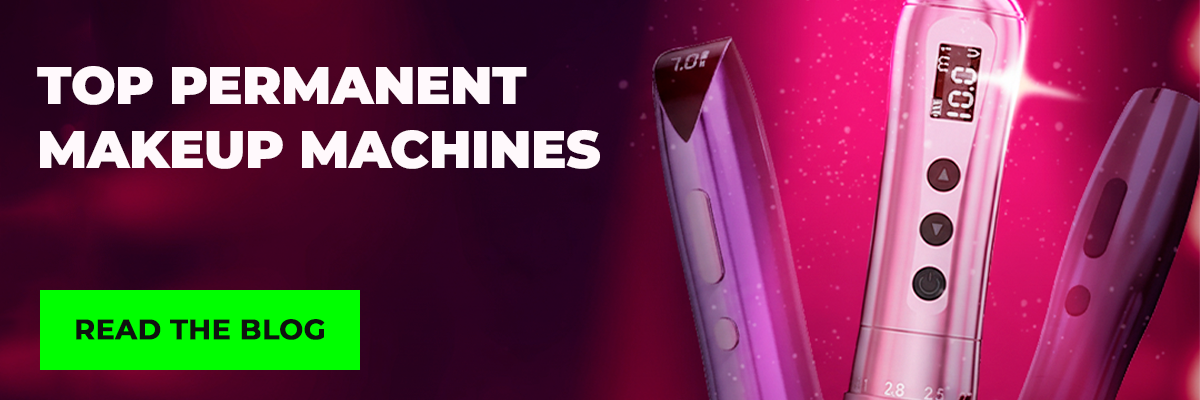
Remember: an ideal result depends not on the power of the machine, but on its stability and ability to work at low voltages. A good tool provides control over the pigment penetration depth and helps create the perfect powder gradient.
Which pigment should you choose for powder brows?
Unlike microblading, where one saturated shade is used, in the powder brow technique, several pigment shades are combined to create a smooth gradient from light at the base to darker at the tail. This creates a volume effect and light shadow shading, as if the eyebrows were neatly highlighted with powder.
What to look for when choosing a pigment:
- Formula. For powder techniques, water or glycerin-based pigments are suitable. They lie down evenly and do not give excessive color density.
- Shade. It is better to choose a color according to the skin phototype and hair tone. For blondes — warm, light brown, or taupe shades; for brunettes and dark-haired individuals — cold brown, gray-brown, and chocolate shades.
- Color durability. High-quality professional pigments, such as Biotek, The Mineral, Perma Blend, OREX, do not shift to red or gray undertones after healing and maintain color for up to 1.5–2 years.
Which cartridge should you choose for the powder brows technique?
To get airy, pixelated shading, it is important to choose the right cartridge. Optimal characteristics:
- Needle diameter 0.25 mm. This is considered the gold standard for powder techniques.
- Long Taper (LT) sharpening. This is a sharp taper that ensures the most delicate pigment implantation without damaging the skin.
Another important parameter that determines the nature of the stroke is needle stiffness. If the needle is stiff and hardly bends, it is ideal for the hair stroke technique, where precise drawing is required.
If the needle is soft and flexible — it is the ideal option for the powder technique. Such needles create a delicate, "airy" effect and a beautiful pixel structure without gaps or spots.
It is also important for the needle to be short; otherwise, control over the penetration depth deteriorates, and the skin can be damaged.
For working with powder techniques, technicians choose single-needle cartridges (1RL) or triple configurations (3RL/3RS), which allow for softly distributing pigment, making the gradient as smooth as possible.
Anesthesia and hygiene products
Client comfort during the procedure is an important point to take care of. Pain thresholds are individual: some feel only a slight tingling, while others may experience discomfort, especially if the skin is sensitive.
Lidocaine-based cream anesthetics are used for pain relief, such as:
- TKTX;
- Sustaine Blue Gel;
- Super Numb.
The preparation is applied to the skin for 15–20 minutes before the procedure under film so that the product acts more deeply. If pain is felt during work, you can additionally use a gel with lidocaine, which enhances the effect and reduces irritation.
During work, the technician must use disposable protection and hygiene products:
- sterile gloves;
- disposable mask and hair cap;
- antiseptic for the technician's hands and client's skin (for example, AHD 2000 Express or BioLong);
- disposable film and tips for the machine;
- sterile pigment cap.
Observing all hygiene standards is a mandatory condition that guarantees the safety of the client and the technician at all stages of the procedure.

Cons of powder brows
Like any micropigmentation technique, powder brows have their downsides that should be considered before deciding on a session:
Cost. Perhaps this is the main downside that often stops clients. In professional studios in Kyiv, the cost of the service ranges on average from 1000 to 4500 UAH. And after 4–6 weeks, a correction is mandatory, which costs about 50% of the initial price. Cheap services for 700–900 UAH should be a warning sign: low price often means saving on pigments, sterility, or equipment, which means the risk of getting a poor-quality result.
Need for correction. Some clients think that one procedure is enough. However, the downside of powder brow shading is that the touch-up is a mandatory procedure. After healing, part of the pigment may lighten or come out unevenly. The correction will fix the color and bring the shape to perfection, but all this requires additional costs and time.
Limitations during the healing period. After the procedure, for a few days, you will have to give up active workouts, saunas, swimming pools, and makeup in the brow area. It is also important to strictly follow care rules to prevent inflammation and color loss.
However, if you weigh all the "pros and cons," powder brow shading is a delicate procedure, but only provided that it is performed by a certified specialist using professional materials. And if you weigh the pros and cons of powder brows, it becomes obvious that the advantages clearly outweigh them.
Pros of powder brows
If you consider powder brow shading, the procedure has far more advantages:
- Minimal skin trauma. Pigment is introduced with micro-needles only 0.5–1 mm deep, so the procedure is considered as gentle as possible. After the session, the skin recovers quickly, no scabs form, and mild redness passes in a few hours.
- Natural effect. The main advantage is the airy, pixelated shading that creates a shadow effect. After healing, the eyebrows look natural, without sharp lines and harsh contours. You can vary color density to achieve the ideal shade for your hair tone.
- Effective correction of visual defects. Powder shading allows you to correct asymmetry, make eyebrows visually thicker and neater.
- Convenience and time-saving. The procedure lasts about 1.5 hours, and the result is preserved for up to two years. The client does not need to fill in their eyebrows daily with a pencil or shadow, as the shape and color always remain ideal.
- Versatility. The technique suits girls and women of any age, as the technician can choose an individual shade and degree of shading.
Powder brows: day-by-day healing
Eyebrow healing takes approximately four weeks. And the final result depends on how the client cares for the skin.
The first and second days — this is the skin's adaptation to the pigment. Immediately after the procedure, the eyebrows look brighter than you might want; slight swelling appears. The shade seems too saturated, but don't worry — this is a temporary phenomenon. In just a couple of days, the color will even out. What is prohibited during this period:
- washing with hot water;
- using decorative cosmetics.
It is enough to wipe the eyebrows with an antiseptic, for example, chlorhexidine, and apply a thin layer of healing cream recommended by the technician.
On the third–fifth day, the skin gradually recovers. Typical signs of regeneration:
- slight tightness;
- dryness;
- barely noticeable peeling.
The thin film that forms is natural protection, so you shouldn't try to peel it off. A new layer of epidermis forms under the crust, and any rough intervention can damage the pigment, leaving light spots.
On the fifth–seventh day, active regeneration begins. The skin peels, and the crusts fall off on their own. It is during this period that clients often think that the color has "gone away" or become too light, but this is a deceptive impression. After the epidermis is completely restored, the color will appear again, only in a more natural form.
Approximately by the tenth day, the skin looks clean, without peeling, but the pigment is still stabilizing. This is the time when the powder brows healing stages are nearing completion, but it is still too early to judge the result. The color will change until the end of the third–fourth week, gradually becoming deeper and more even.
Only after three to four weeks can you see what powder brows look like after healing. They become natural, lose their initial saturation, and the color transitions from the base to the tail look natural. This is the final result, which is maintained for up to one and a half to two years.
To ensure the pigment sets evenly and does not fade too quickly, it is important to follow a few simple rules:
- In the first two weeks, it is worth avoiding contact with hot water, steam, saunas, and swimming pools. A humid environment interferes with skin recovery.
- You cannot use peels, acids, or heavy oils. They can "pull out" the pigment and disrupt the structure of the new skin layer.
- In the sun, especially in summer, you must apply SPF; otherwise, the shade will fade in just a few months.
A good helper during the recovery stage will be Bepanthen or After PM cream, which helps the skin heal faster and retains moisture. After full recovery, you can add light moisturizing products without alcohol to extend color durability.
If you strictly follow the technician's recommendations, the healing of powder brows by day passes comfortably and without complications. The difference between powder brows before and after healing is visible to the naked eye: at first, they are saturated, sharp contours, and in a month — airy, velvety, as if lightly tinted with powder.
This is how the healing stages of powder brows go step by step. And it is competent home care that helps preserve the effect for a long time.