Strong eyebrow asymmetry is one of the most common requests from clients to a brow artist. Today, Beauty Hunter will talk about how to work with eyebrow asymmetry – what techniques to use, how to correct the brow shape, how to select lines correctly, and what recommendations to give the client to achieve the most symmetrical and natural result possible!
Imagine that there is a ranking of brow artist nightmares... One of the top spots would definitely go to strong eyebrow asymmetry. More precisely, not the phenomenon itself, but the client's desire to quickly make the eyebrows maximally symmetrical given this feature. Unfortunately, in most cases, attempting to correct strongly pronounced asymmetry leads to a fiasco: the artist either fails to satisfy the client's wish, or the disproportion becomes even more noticeable.
Therefore, the question arises: how to work with strong eyebrow asymmetry, what techniques should be used, and what should be avoided?
What is asymmetry and what are its types?
It is a generally accepted fact that every person has some degree of asymmetry in their facial features. This is the unevenness of the right and left halves of the face. The cause of such asymmetry is mainly the unevenness of the skull bones, and its intensification is explained by the specifics of a person's facial expressions. Furthermore, it is interesting that manifestations of asymmetry have a regular pattern: if one half is higher, it will also be narrower. In this case, the eyebrow will also be located higher than on the opposite, wider half of the face.
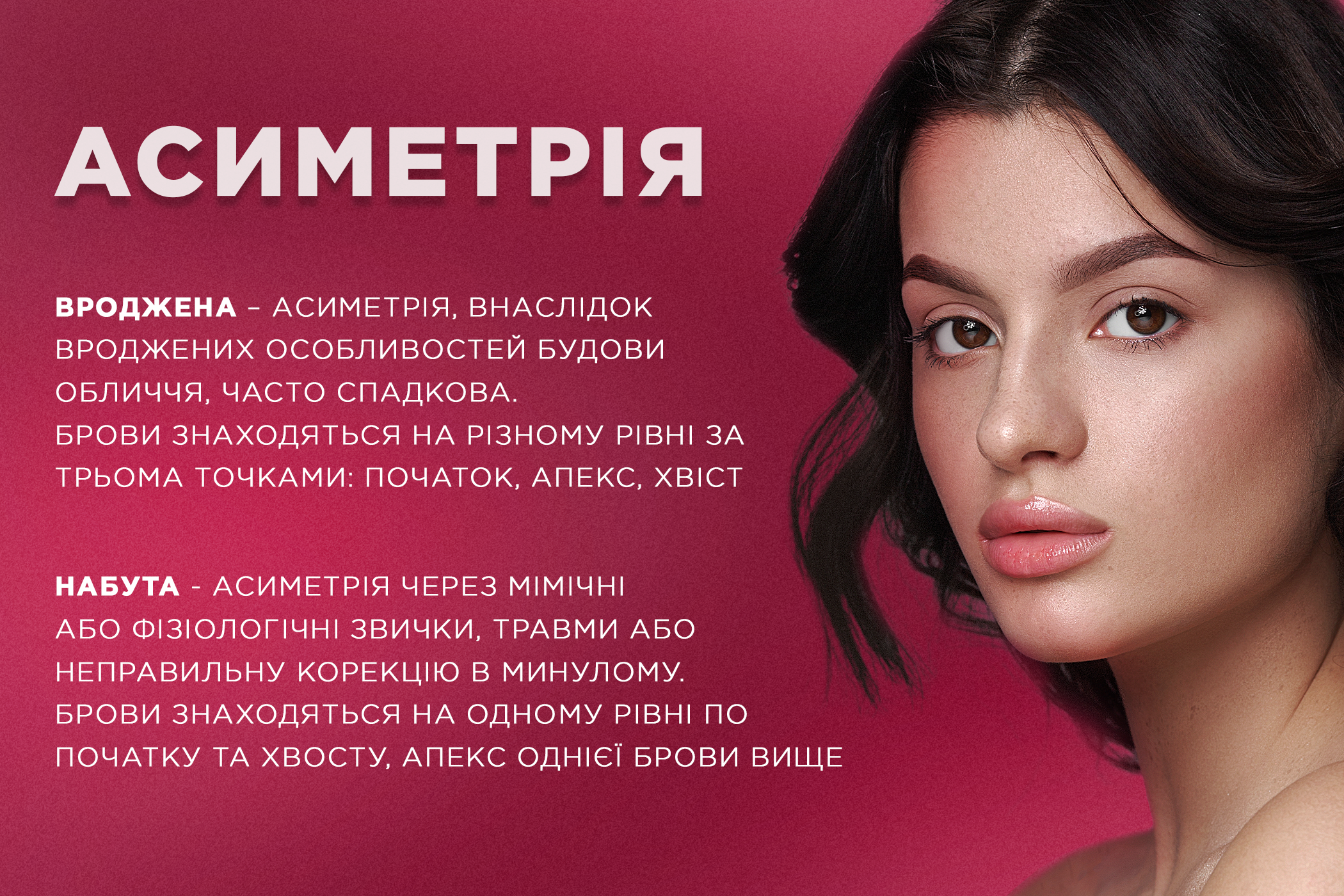
There are two types of asymmetry - congenital and acquired.
Congenital asymmetry - eyebrows are at different levels according to three points (start, apex, tail). Such disproportions arise due to congenital features of the skull structure, often due to heredity. A client with congenital eyebrow asymmetry will also have a different eye shape.
Acquired asymmetry - eyebrows are at the same level according to these points: start, tail. But the apex of one brow is higher than the other. The cause of acquired asymmetry of the eyebrows and face, as a rule, is mimic and physiological habits, or past injuries or diseases. Another very common cause is incorrect eyebrow shaping in the past. Over-plucked eyebrows are a shared pain for both the client and the brow artist.
How to correct strong eyebrow asymmetry?
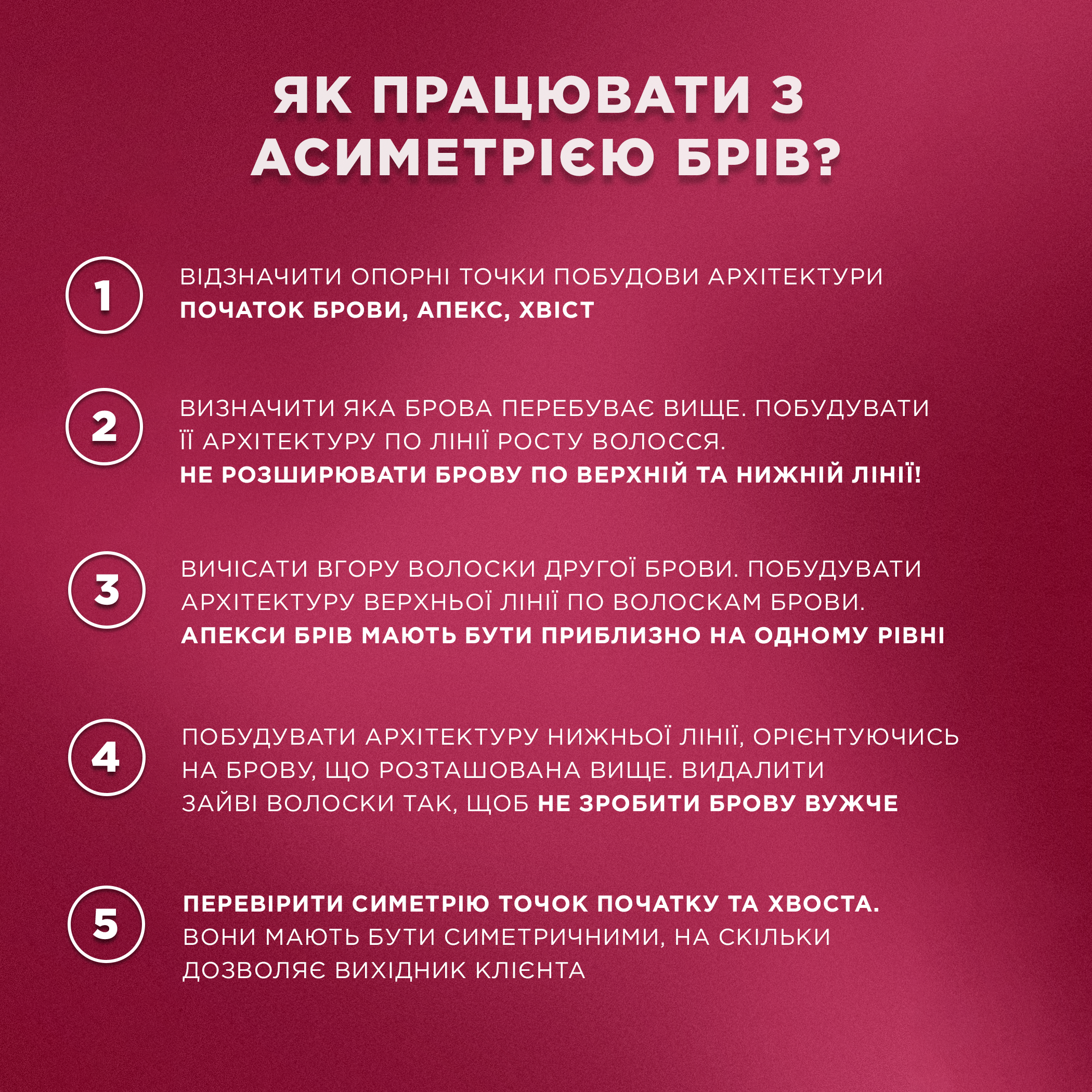
Professional eyebrow modeling, as well as tinting of the eyebrows and skin, will help visually correct asymmetry. It is important to follow this step-by-step approach in your work.
- Mark three anchor points to build the correct eyebrow shape - the start of the brow, the apex, and the tail.
- Determine which eyebrow is higher.
- Draw the brow that is higher, following the hair growth line. At the same time, try not to widen the brow along the top and bottom lines.
- Now move on to the eyebrow that is lower: brush the hairs upward. This will give you the opportunity to see how much the second brow can be visually lifted with the help of tinting.
- Draw the upper line to the width that the eyebrow hairs allow. The apexes of the eyebrows should be approximately at the same level.
- Draw the bottom line. Use the eyebrow that is located higher as a guide. Remove extra hairs, but be careful with the brow that is lower so as not to make it too thin.
- Check the starting points and the tails to ensure they are at the same level (as much as possible).
What should not be done when working with strong eyebrow asymmetry
When working with eyebrow asymmetry, there is a great temptation to resort to active correction of the brow architecture. But this should not be done, and there are several reasons for this.
First of all. An artist can easily change the shape of the brow using modeling and tinting with a long-lasting dye. The client, of course, will be very happy because they got what they wanted - identical eyebrows. But after just a few days, they will run into problems: the tint will fade from the skin, and the client will no longer be able to repeat all those eyebrow manipulations that an experienced brow artist performed.
Secondly. It is important to consider that if there is strong asymmetry of the eyebrows and eyes, and we want to make the brows identical, the asymmetry of the eyes may become even more noticeable. It is necessary to take this feature into account and not resort to overly active changes to the brow shape.

Psychological aspects of working with eyebrow disproportion
Sometimes there are cases when strong eyebrow asymmetry arose precisely because of poorly executed architecture and shape correction in the past. In such a case, you can perform shape correction as much as possible and give the client "homework" - to grow out hairs to build the correct shape in the future. It is necessary to explain to the client exactly where it is better not to touch the hairs at all if they want to remove them themselves between corrections. Also, as a nice bonus to the service, you can show how to draw the eyebrow shape using decorative cosmetics or how to style the hairs with fixing agents. This will come in handy when the tint fades from the skin, and the client will need to maintain the brow shape or apply makeup.
It is also important to explain a basic truth to clients: brows are sisters, but not twins. We can make them somewhat similar to each other, but by making them absolutely symmetrical, we will highlight the asymmetry of the eyes and face, achieving the completely opposite effect.
It is important to observe the principle of "everything in moderation," and while working with asymmetry locally, try not to disturb the overall harmony of the client's facial features.