Choosing the right and suitable product for every client's need is the foundation of a good result in eyebrow tinting. Many brow artists often cannot decide what is better to work with: eyebrow dye or henna. In this blog, Beauty Hunter will break down in detail the differences between the dye and henna from the Zola brand.
Choosing the right and suitable dye for every client's need is the foundation of a good result in eyebrow tinting. Each case requires an individual approach.
Brow artists often ask the question, "what is better to work with: eyebrow dye or henna?". Both products give excellent results but have different properties, effects, and application peculiarities.
In this blog, Beauty Hunter will break down in detail the differences between the dye and henna from the Zola brand.
What is the difference between ZOLA dye and henna?
To begin with, let's define the main criteria for comparing the two products — dye and henna; it is precisely within these criteria that the significant differences for the final tinting result lie.
The criteria we will use to compare Zola dye and henna are:
- product texture;
- coloristics;
- what effect the product gives;
- duration of the effect on hairs and skin;
- usage after lamination;
- peculiarities of working with the product;
- in which cases it is better to use dye or henna.
These are the main criteria by which every brow artist, even a beginner, will be able to choose which product is better to use for tinting.
What is the difference in texture between ZOLA dye and henna?
It is important to understand that dye and henna are fundamentally different products in terms of texture.
Zola dye is a professional permanent dye with a creamy texture that requires mixing with an oxidant to activate skin and hair tinting. The ready-made mixture has a creamy texture that is convenient to work with even for beginner brow artists.
Zola henna is a professional hybrid dye with a dry, powdery texture. It needs to be mixed with purified water or a special mineral solution (which gives a more lasting and predictable result). The ready-made mixture has a thinner consistency, so it is applied in layers and requires drying on the skin to achieve the result.
It should be noted that both products, both dye and henna, must only be mixed in a glass or plastic container, as a metal container can oxidize and affect the properties of the tinting mixture.
What is the difference in coloristics between Zola dye and henna?
The basic shades in the Zola henna and dye palettes are similar; the palettes of both products contain Light Brown, Brown, and Dark Brown shades. But that is where the coloristic similarity ends.
The Zola dye palette consists of 7 shades. Zola henna has a wider palette than the dye: 6 main shades + 4 correctors.
Let's consider the dye and henna palettes from the Zola brand in more detail.
Zola dye shade palette
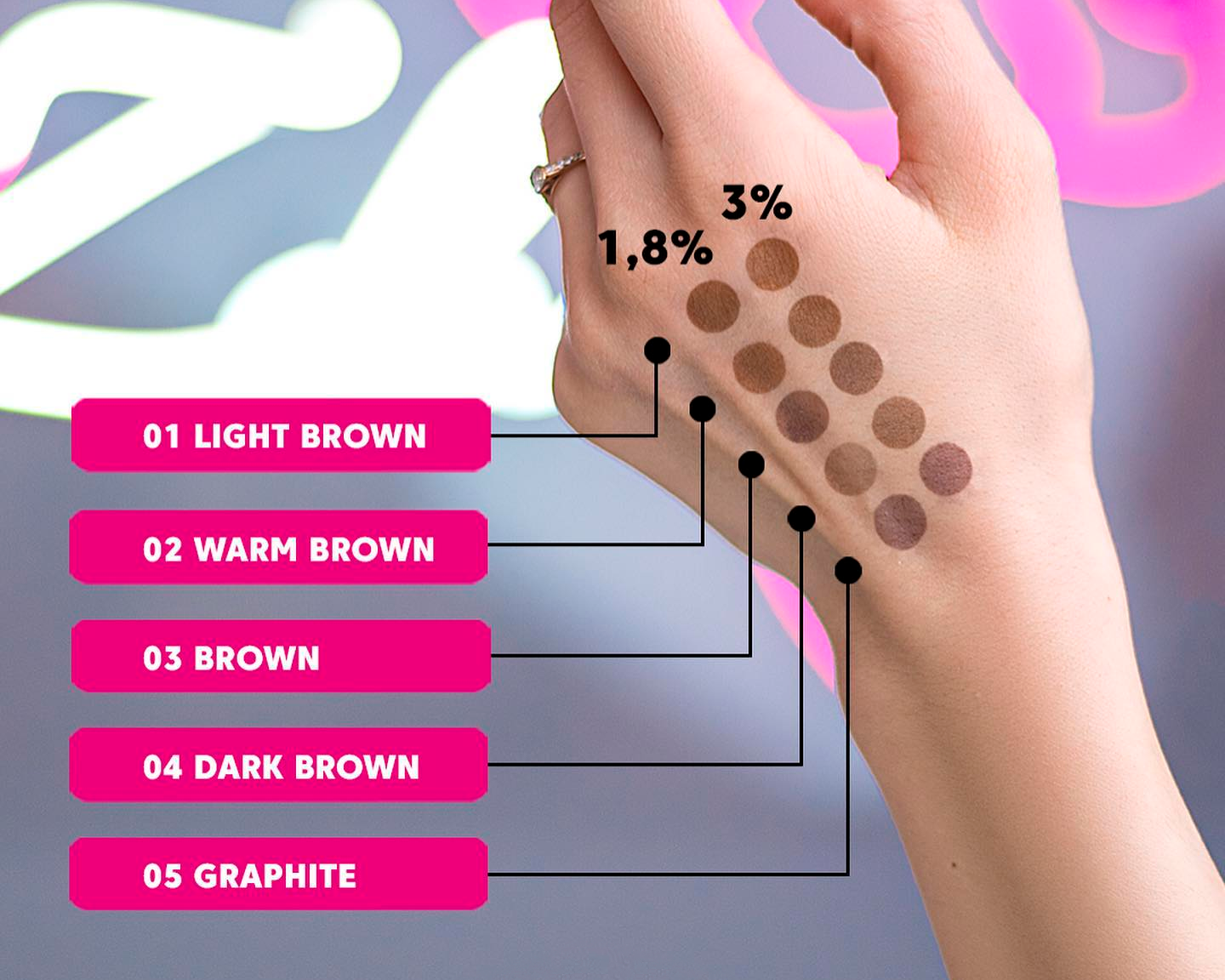
In the Zola dye palette — 7 shades, of which 5 shades are for eyebrow tinting, 1 shade for eyelash tinting, and a special product, Tint Mixer, with which you can control color intensity.
- 01 Light Brown — light brown
- 02 Warm Brown — warm brown, copper shade
- 03 Brown — neutral brown
- 04 Dark Brown — dark brown
- 05 Graphite — cold graphite shade
- 06 Blue Black — black shade with a blue undertone for eyelash tinting
- 07 Tint Mixer — special "colorless" dye for adjusting the intensity of other shades in the palette
To activate the dye, a 3% or 1.8% oxidant is used.
3% Oxidant — for a more saturated result and skin imprint.
1.8% Oxidant — for a softer result and tinting after lamination.
All shades in the dye palette can be mixed together to obtain a unique color tailored to the client's needs.
Zola henna shade palette
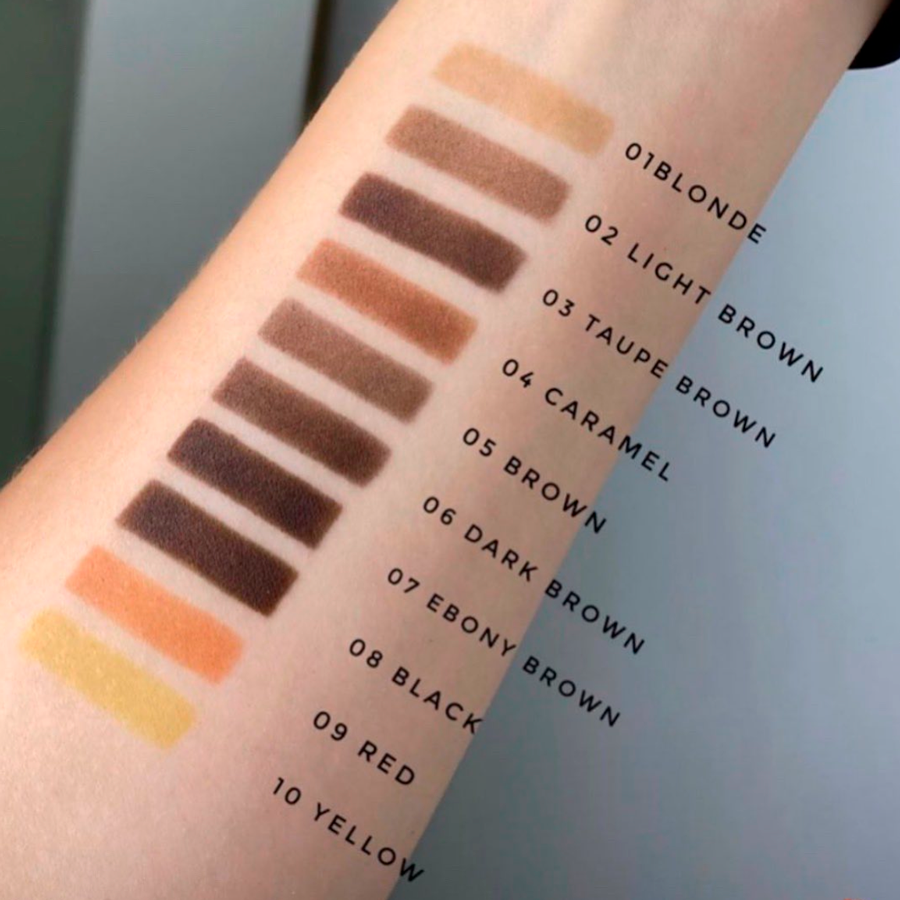
In the Zola henna palette — 10 shades, of which 6 are main shades for eyebrows and 4 are correctors used to adjust undertones.
- 01 Blonde (corrector) — very light, adds softness, especially for light eyebrows. Ideal in combination with 03 Taupe Brown, 02 Light Brown, 05 Brown.
- 02 Light Brown — light brown, natural for light brown hair
- 03 Taupe Brown — cold taupe-brown, very "powdery" effect
- 04 Caramel — warm caramel shade, fits well for warm skin tones
- 05 Brown — universal brown, neutral undertone
- 06 Dark Brown — rich dark brown for brunettes or more dramatic brows
- 07 Ebony Brown — very dark brown, almost black deep shade
- 08 Black (corrector) — for darkening the main palette, adds a darker shade.
- 09 Red (corrector) — for adding warmer reddish notes to the main palette for red-haired girls with warm undertones
- 10 Yellow (corrector) — for adding a warm, "yellowish" undertone to the main palette
All henna shades can be mixed together to obtain the desired color.
Correctors are not used in pure form for tinting — only for adjusting the undertone of the main palette.
To activate tinting, purified water or a special Zola Henna Mixer activator is used. We recommend using the activator specifically, as it enhances color intensity and makes the tinting more lasting and even.
Peculiarities of working with Zola dye and henna
Zola dye is quite easy to work with even for beginner brow artists. The application technique is maximally simple: the ready-made tinting mixture is applied to the brows according to pre-formed architecture and mapping and washed off after exposure with a damp sponge.
Saturation adjustment is achieved by using different oxidants (3% or 1.8%) and the special Tint Mixer shade, which has no color and "dilutes" the main shade.
Zola dye processing time: 5-15 minutes depending on the desired result.
Zola dye can be used for eyelash tinting and after eyelash lamination or eyebrow lamination. In these cases, it is recommended to use a 1.8% oxidant to avoid darkening.
Zola henna allows you to work in different techniques, such as layering or filling, so it requires additional knowledge about working with a product like henna.
Henna tinting takes a little longer because henna needs to dry to achieve a lasting result.
Saturation adjustment is achieved by the consistency of the tinting mixture. Henna can be mixed in a 1:1 ratio or up to a soy sauce consistency. Depending on the consistency, henna will lay down brighter or paler — the thicker the consistency, the brighter the result.
Zola henna processing time: from 20 to 40 minutes depending on the desired result.
It is important to note that henna is not recommended for eyelash tinting or after lamination.
What result do Zola dye and henna give?
Zola dye lasts on the hairs for 3–4 weeks and up to 7 days on the skin. It gives a rich color on the hairs but is easier to fix on the skin. It has a softer effect and is suitable for clients who want a natural result.
Dye is ideal for thick eyebrows or when there is no need for a strong imprint on the skin.
Zola henna lasts on the hairs for up to 6 weeks and up to 2 weeks on the skin. It gives a rich, clear, and graphic imprint on the skin without darkening the hairs. It is suitable for clients who have gaps in the eyebrow area, require significant shape correction through tinting, or simply need an expressive and graphic effect.
Please note that the durability of the imprint for both dye and henna strongly depends on the characteristics of the client's skin. On clients with dry skin, the imprint lasts longer, and on clients prone to oily skin, it lasts less.
Comparison of ZOLA dye and henna by key criteria
| Comparison criterion | Zola Dye | Zola Henna |
| Texture | Creamy dye | Dry product, liquid after mixing |
| Shade palette | 7 shades (5 main palette shades + 1 eyelash shade + Tint Mixer) |
10 shades (6 main palette shades + 4 color correctors) |
| Durability | up to 7 days on skin up to 3–4 weeks on hairs |
up to 2 weeks on skin up to 6 weeks on hairs |
| Effect | Soft, natural | Expressive, graphic |
| Eyelash tinting | ✅ | ❌ |
| Tinting after lamination | ✅ | ❌ |
| Color adjustment | Via Tint Mixer and oxidant (3% or 1.8%) | Via palette correctors and mixing consistency |
| When to use | For clients with thick, natural brows For clients who want a more natural result For tinting after lamination and brow lamination |
For clients with gaps in the brow area For significant shape correction through tinting For a saturated, graphic result |
Conclusion on comparing Zola dye and henna
Dye and henna from Zola are two fundamentally different products for eyebrow tinting, each of which has its own advantages and work peculiarities. Dye is suitable for those who love a soft, natural result, while henna is for an expressive, well-groomed, and graphic effect.
In our work, we recommend having both products, as they cover completely different client needs.
In this blog, we have provided a detailed breakdown of all the peculiarities of working with Zola dye and henna, so now you have all the information to choose the right product for the best result.