A brow artist is a true artist, and brushes are an extension of their hand. Today, using Creator Synthetic brushes as an example, we will look at which brushes a brow artist needs for their work.
Hello, dear brow artists! This blog is for you!
Can a brow artist be called an artist? Of course, yes! A brow artist is an artist who shapes eyebrows, and brushes are an extension of their hand. Therefore, it is extremely important for a brow artist to choose brushes that will allow them to create masterpieces, making the process itself comfortable and enjoyable.
How should a brow artist choose brushes for their work?
The famous sculptor Rodin said that art is nothing but feeling. But without knowledge of volumes, proportions, color, and without a masterful brush, any living feeling becomes impossible.
Today, a very wide range of tools for eyebrow styling is available. It is often quite difficult to choose what you need. Therefore, to find a good assistant, a brow artist needs to understand what actions will be performed in the process of work and which brushes will cope with a particular task. You also need to know what brushes exist in general and what to look for when choosing them.
Main characteristics of brushes for a brow artist:
- material from which they are made (natural or synthetic);
- bristle density (flat, fluffy);
- shape (straight, angled, rounded, "petal," etc.)
Most often, brow artists use brushes with synthetic bristles (taklon, nylon). It is very practical: it does not lose its shape from dye or henna for a long time, does not stain, and is easily cleaned. The difference between taklon and nylon is that taklon is softer, it mimics natural bristles. And nylon is stiffer, which has its advantages: for example, when you need to achieve clear, even lines when sketching or tinting.
Brushes for skin preparation before tinting
Now let's look at the main stages and the corresponding brushes.
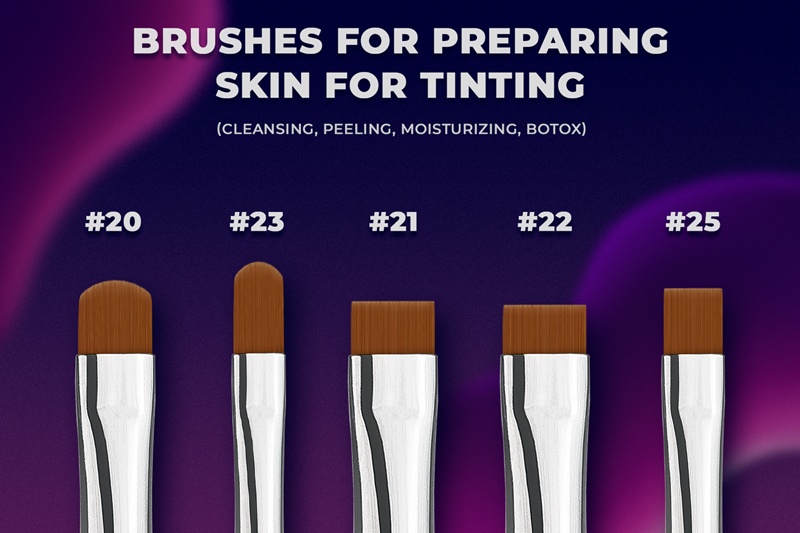
How does the eyebrow styling procedure begin? Usually with skin preparation. First, the artist uses a cleanser and degreaser, shampoo, or mousse. Distribute it over the entire eyebrow area with a disposable spoolie. Depending on the type and condition of the skin, a scrub, moisturizing cream, Botox, or oil may additionally be used. It is convenient to apply these products not with a spoolie, as for shampoo, but with a brush. It can be flat, wide, with a straight edge, or rounded.
You can pay attention to Synthetic Creator No. 20, 23. They are rounded. And with a straight edge - 21, 22, 25.
The size is selected depending on the application area: the larger it is, the larger the brush needed, as it will be faster. In cases where the product needs to be distributed locally, use a medium or small brush.
Important: if the brow artist uses dense textures, for example, a scrub, it is better to choose a firm brush, but if it is an oil, you can take a softer brush. In working with oils, it is appropriate to use synthetic brushes, as this material does not absorb the product the way natural bristles or a cotton swab would.
Brushes for building eyebrow architecture and sketches
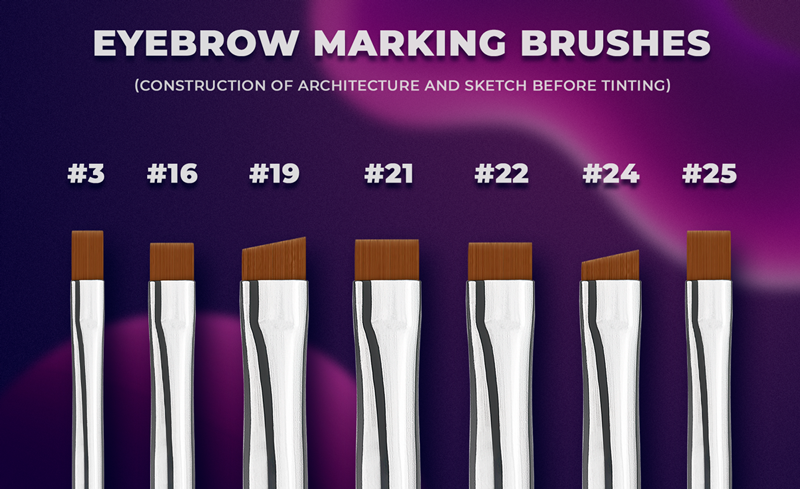
The next step is building the sketch. For this, a brow artist also needs synthetic brushes that are firm, not soft. Especially when the artist is working with brow paste. For perfectly clear lines, it is better to choose not a rounded brush, but a straight or angled one. You can use it to outline the frame of the eyebrow with shadows, paste, or a pencil.
Synthetic Creator No. 3, 16, 19, 21, 22, 24, or 25 will come in handy.
They are different: there are straight and angled, narrow and wide, short and long ones. You don't need all of them at once; you can choose the tool that is convenient for you from the list. They are also excellent for correcting the sketch when you need to fix a line. This can be done with the same brushes, but after first cleaning them of leftover shadows or paste.
Brushes for brow tinting
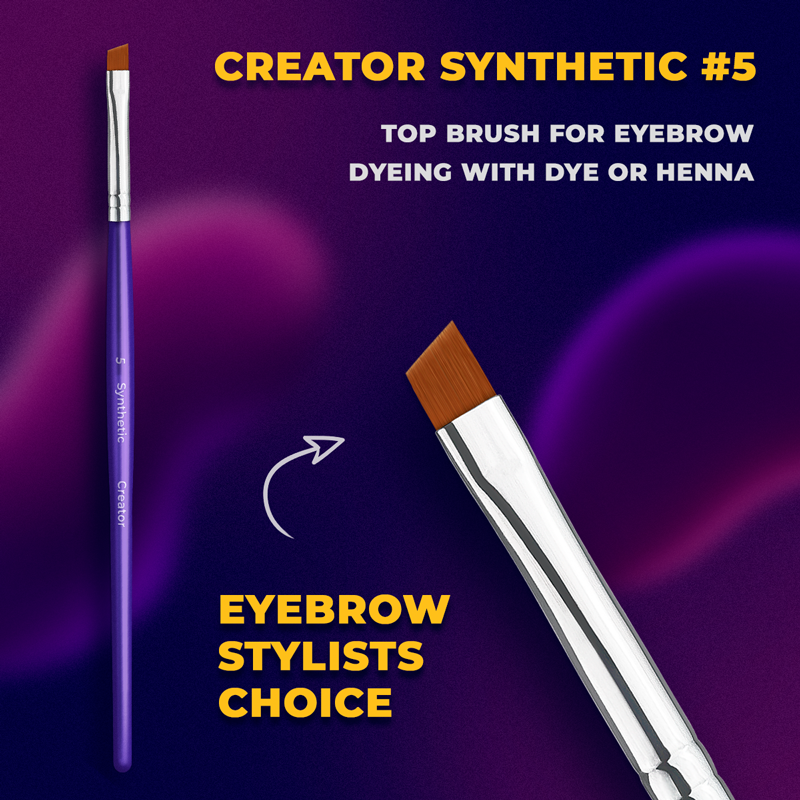
We are moving on to a very responsible stage - brow tinting. This means that the assistants must also be reliable and proven. Synthetic Creator No. 5 has won great love and respect from brow artists. It is perfect: flat, angled, firm, and comfortable to hold in the hands. You can apply both dye (cream or gel) and henna with it. There is a similar one, but shorter - this is No. 5.
Brushes for brow and lash lamination
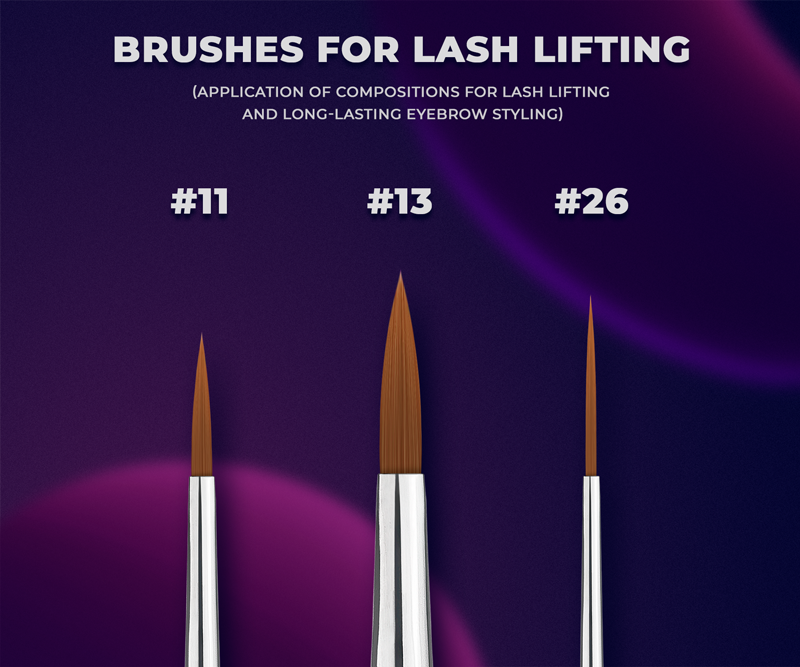
For work, a brow artist will also need separate brushes for the brow lamination (long-term styling) procedure. This service is very popular among clients, so the artist must have everything necessary for it. For applying compounds in a thin line, the brush itself should be thin.
Synthetic Creator No. 11, 13, 26 are suitable for applying compounds. They vary in size, but in general, they are all thin, just right for precision work.
Important! For compound 1 and 2, it is better to choose separate brushes rather than working with one. To avoid confusion, you can choose different sizes: for compound 1, take a thinner one (since the compound itself is applied in a narrower line), and for compound 2 - a thicker one.
When we are tinting lashes during lamination, or even when it is a separate procedure, it is very convenient to use a wide brush, as it grabs and tints many lashes at once. As we already mentioned, these can be No. 20, 23 (rounded) or 21, 22, 25 (straight).
Of course, every brow artist has their favorite tools that they use more often. The main thing is that the brushes are truly comfortable for work, as this is the artist's main working tool.
It is also equally important that they always look good. Clients pay attention to the design and neatness of the brow artist's workspace, as it is all right before their eyes. Therefore, it is very important to keep the work area in order, take care of the tools, and replace them in time with those that look presentable and neat.
Let's not forget that we are beauty masters, which means that the space around us should also be beautiful!